
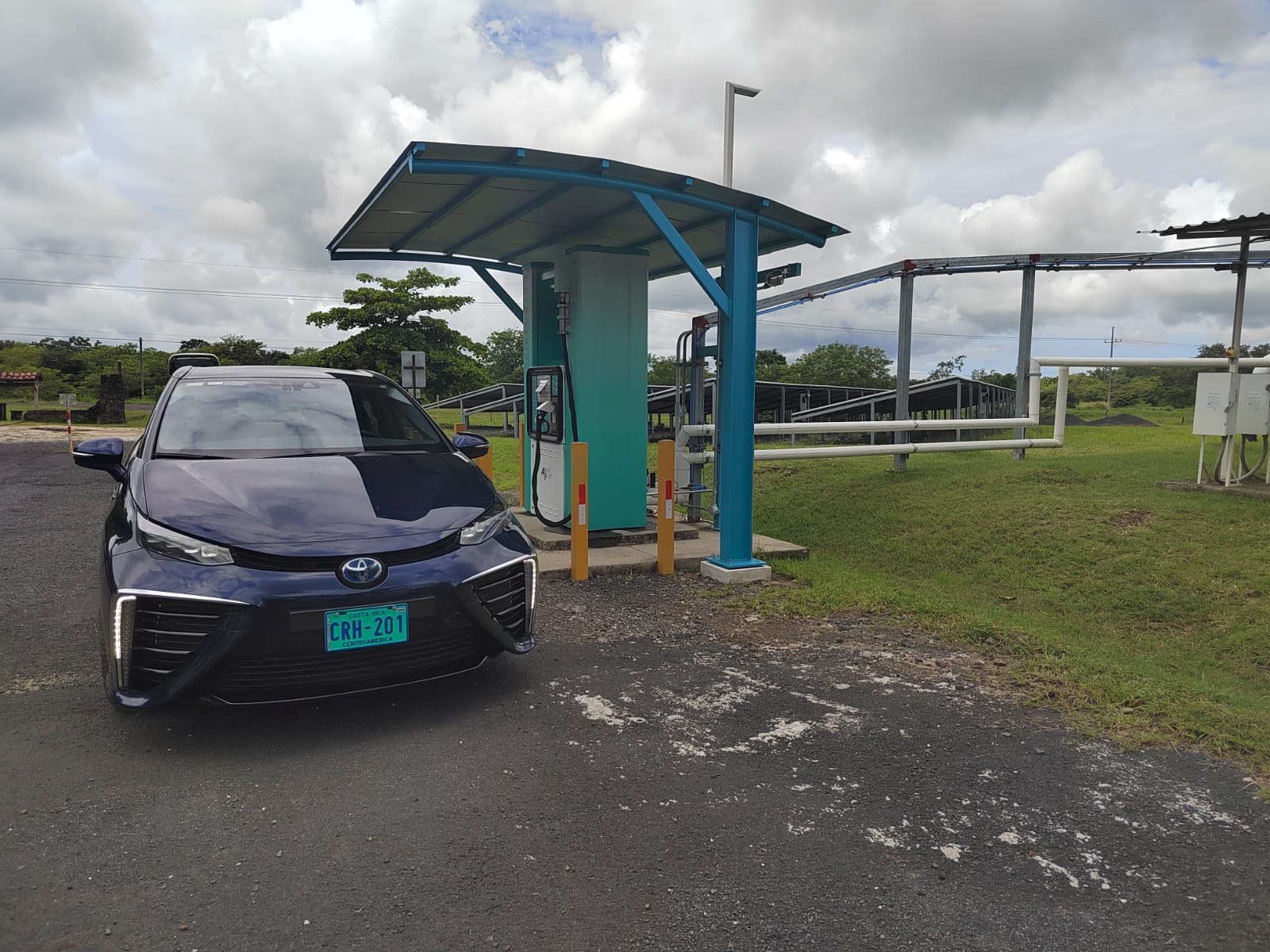
Costa Rica takes the next leap towards decarbonization with green hydrogen
Mitigation Action Facility confirms project for 25 million euros.
What began as an application for a financing competition ended with the approval of an ambitious project for an amount of € 25,000,000, which will enable Costa Rica to invest in the development of green hydrogen as a complementary alternative to the decarbonization of its economy.
This was recently announced by the Mitigation Action Facility (MAF) to Costa Rica’s Deputy Minister of Energy, Ronny Rodríguez.
For us it is extremely important to start generating knowledge through projects where we have financial support in the initial stage, so that once the project is developed, the information is open so that we can see what is the investment that is being used, what are the benefits to the environment, what are the benefits of a social nature and economic nature and from there generate what we call a hydrogen ecosystem”.

Ronny Rodríguez, Costa Rica’s Deputy Minister of Energy.
The project Green Hydrogen for a Decarbonized Economy in Costa Rica aims to use this clean energy as an alternative for sectors that cannot be easily electrified, such as the cement industry and heavy-duty transport.
The project has two main components. On the one hand, financial assistance to support initial investments in green hydrogen projects through concessional credits and subsidies, which are necessary as it is a new segment of the economy with high initial costs. On the other hand, technical assistance to develop human and institutional capacities, adjust the legal and regulatory framework as necessary, formulate strategies to generate positive social impacts such as job creation, etc. Overall, we want to support the government of Costa Rica in the implementation of the National Green Hydrogen Strategy.”
Claus Kruse, interim project director for the German Cooperation GIZ
This is a unique model, it means that Costa Rica has great support, and it becomes an opportunity to create capacity of the private sector, the public sector together with the stewardship of the State to be able to venture into a new energy. We need to decumulate carbon in the atmosphere, and this is one of the forms of energy that has all the potential for the future. The idea is to generate knowledge for new generations and give them one more tool to mitigate the effects of climate change.”
Ronny Rodríguez, Costa Rica's Deputy Minister of Energy
In the medium term, hydrogen hubs could be formed in the country, which bring together not only green hydrogen production projects, but also its use in transport and industry projects, as well as other topics such as technical and vocational training, certification, research and several other topics.
Costa Rica has very favorable conditions for the development of green hydrogen. It has an almost 100% renewable electricity matrix and has the oldest experience in Latin America thanks to the initiative of Franklin Chang and Ad Astra. In addition, the country's political and economic stability, coupled with internationally recognized efforts to advance environmental and climate issues, enable Costa Rica to have the support of friendly countries, as demonstrated by this project.”
Claus Kruse, interim project director for the German Cooperation GIZ
In May 2021, the German Development Cooperation GIZ submitted, on behalf of the Costa Rican government, a proposal to the MAF (then NAMA) to compete for funds to develop a green hydrogen project in the country. In October of the same year, during the United Nations Climate Change Conference in Glasgow (COP26), it was announced that Costa Rica’s proposal had been selected, thus becoming the only one selected from Latin America and the first in history to carry out a project of this type in green hydrogen.
The project will formally begin on September 1st of this year. The German Development Cooperation (GIZ) will be the organization in charge of its implementation.
The Mitigation Action Facility is a multi-donor fund, which aims to finance the implementation of ambitious and transformative projects that drive the decarbonization of economies in their different sectors to mitigate the negative effects of climate change.