
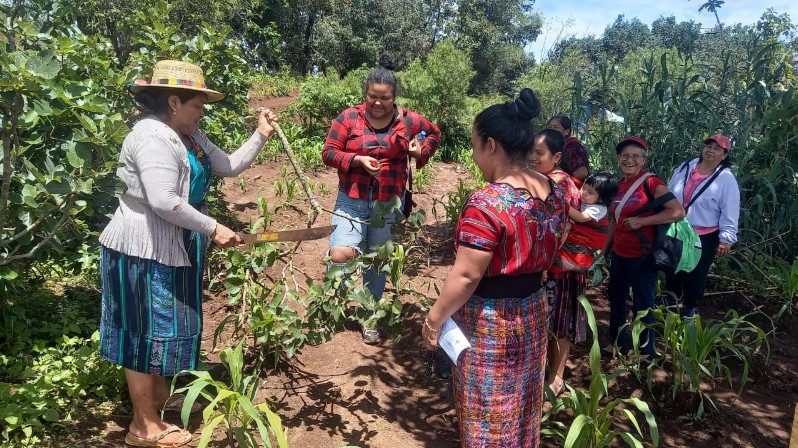
Guatemalan women leaders share experiences for ecosystem-based adaptation in field trips
Guatemala
During the tours, held on June 26th and 27th, and between July 2nd and 5th, 2024, they visited two demonstration plots led by CADERES women in the municipality of Santa Cruz del Quiché where EbA measures are implemented thanks to the technical advisory and training processes implemented by the Ministry of Agriculture and Livestock (MAGA). and with the support of the EbA LAC Program.
During these visits, the leaders, from the municipalities of Quiché, San Bartolomé Jocotenango, San Pedro Jocopilas, San Tomás Chiché, San Andrés Sajcabajá and Canilla expanded their knowledge on technical issues, such as the implementation and diversification of orchards and agroforestry systems, and the recovery of ancestral practices through the milpa system, commonly called kuxur rum. The application of sustainable practices was also deepened, such as the production of bio inputs with vermicompost, bioinsecticides, repellents, and the use of aromatic and medicinal species for the control of pests and diseases.

Women leaders participating in technical tours to exchange experiences
Another issue addressed during the tours was the management of soil and water conservation practices within the plots, as well as windbreaks, which, despite these being a practice already implemented, in most cases their benefits for adaptation to climate change were unknown.
To encourage women to position and add value to their products, the experience of leaders who sell their organic products in the market was presented by taking advantage of the current demand and environmental awareness of customers. This has allowed them to have a new income and therefore, improve their economic solvency. In addition, a practice was carried out for the elaboration of by-products with elderberry species, which are ancestrally recognized for controlling soil moisture and that tend to reproduce easily by sprouts through cutting. These plants are used to make food-grade jellies and preserves and medicinal products such as cough syrups or infusions for headaches.
With this training process, EbA LAC seeks to ensure that the trained women leaders can implement ecosystem-based adaptation measures in their plots and then train the women who belong to their CADERES groups as part of the cascade effect model for the horizontal scaling of the EbA.
About the project
These actions are carried out within the framework of the EbA LAC program, funded by the German Federal Ministry for the Environment, Nature Conservation, Nuclear Safety and Consumer Protection (BMUV), through its International Climate Initiative (IKI), and implemented by the German Cooperation -GIZ- as the lead agency, in partnership with the IUCN (International Union for Conservation of Nature) and CATIE (Tropical Agricultural Research and Higher Education Center).
The program aims to increase the resilience to climate change of vulnerable communities and ecosystems in rural areas of Costa Rica, Guatemala and Ecuador. In Guatemala, it is implemented in close coordination with the Ministry of Environment and Natural Resources (MARN).
