
Do you want to know how to measure and monitor the municipal waste stream?
Belice, Guatemala, Honduras, República Dominicana and México
The WFD, or Waste Flow Diagram, is a tool designed by the German Development Cooperation (GIZ) in collaboration with the University of Leeds (United Kingdom) and the companies Wasteaware and Eawag, to assist cities in the management of their solid waste. With this tool, the sources and destinations of waste that leaks into the environment can be quickly identified and assessed, and with this information plans and actions aimed at preventing and reducing these leaks can be carried out.
What is not measured does not exist, and therefore cannot be improved!
To recommend and implement improvements in urban solid waste management systems, a tool was required to provide data and necessary evidence in an agile and simple way, which would allow better informed decisions to be made.
As of June 2022, the regional project Caribe Circular gave an online training with the support of an international expert to learn about and implement the digital tool. The simulation was carried out in the pilot areas of 5 countries: Belize, Guatemala, Honduras, the Dominican Republic and Mexico, whose results can be visualized here.
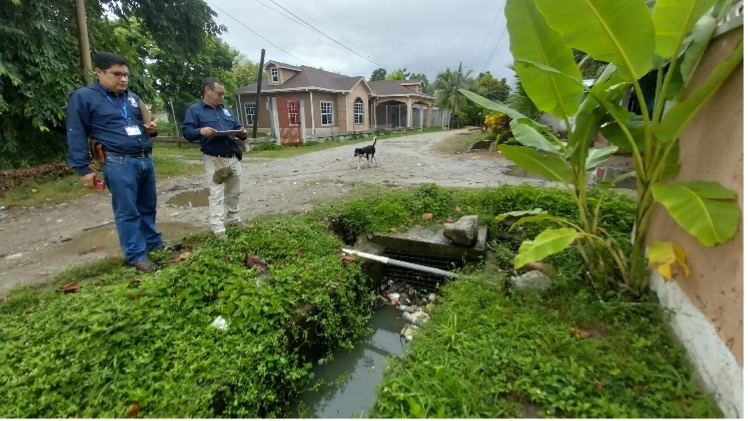
Ángel Sorto lives in Omoa with his wife and son. For 21 years she has been working on community development and environmental programs in the municipality. He is a witness to how «economic development» in the area has been carried out at the expense of the environment, visible in the pollution of rivers and beaches that were once healthy and unspoiled.

For us as a municipality, it was impossible to know how much waste was managed by municipal or informal services, how much ended up in the sea and how much was burned".
Angel Sorto, Municipality of Omoa, Honduras
The WFD has become an invaluable tool for local government, especially for low- and middle-income cities like Omoa, which do not have sophisticated systems or extensive resources for proper waste management.
"When implementing the tool, it was important to address issues that had not been touched throughout the waste management process, such as plastic leaks in the collection and transport stages, which end up reaching water bodies and polluting nature. This enabled us to take into account new criteria to improve decision-making at the municipal level".
Angel Sorto, Municipality of Omoa, Honduras
The WFD made it possible to visualize the baseline on waste leaks in Omoa in 2022. As can be seen in the Image of Sankey’s diagram, of the more than 500 tons of plastic waste generated per year, about 70% (358 t) of the plastics collected by informal services are transferred to final disposal sites (open-air landfills), and in the process, as a result of an inefficient system, about 44% (228 t) of waste ends up on land, 35% (179 t) in water, and only 2% (11 t) was recovered for recycling.
To date, the WFD has been applied in more than 150 cities worldwide. The Caribe Circular project conducted several trainings aimed at technical staff from local governments and ministries of environment, non-profit environmental organizations and universities, which made it possible to raise the baseline in municipalities of the 5 countries. In total, 88 multipliers, especially technical personnel from local governments, were trained in the use of the tool. Ángel was one of the trained technicians.

Sankey diagram generated with the WFD in Omoa.
Currently, the training processes continue and are expanded through an online course, completely free of charge called “Implementer of the Waste Flow Diagram (WFD)”. The course is available on Atingi (https://online.atingi.org/enrol/index.php?id=2722) for those who wish to apply this tool in their municipalities or cities.
About the Caribe Circular Project
Caribe Circular is a regional initiative that seeks to implement innovative solutions for the prevention of plastic waste.
Through collaborations with local communities, the private sector, non-profit organizations and government entities, the project has made significant progress in transitioning to a circular economy and reducing plastic pollution.
It is implemented by the German Development Cooperation (GIZ) in coordination with the Central American Commission for Environment and Development (CCAD) of the Central American Integration System (SICA) and the Government of the State of Quintana Roo (Mexico) through the Secretariat of Ecology and Environment (SEMA). It is funded by the European Union (EU) and the German Federal Ministry for Economic Cooperation and Development (BMZ).